 by
by To be honest, before visiting Jeju Island, my impression of it was simple: an island with sea breezes—a place perfect for taking photos and unwinding.
However, upon arrival, I discovered that Jeju isn’t the sort of island defined by a cluster of tourist attractions; rather, it is a natural landscape woven together from volcanic formations, coastlines, mountainous terrain, and villages. You aren’t driven by the frenetic pace of a city; instead, you are gently guided along by the lay of the land and the wind.
My itinerary focused primarily on Jeju’s natural attractions. I avoided a tight schedule, opting instead for a relaxed approach to experiencing the island’s unique character.
I. Yongduam Rock: The First “Seaside Boundary” After Leaving the Airport
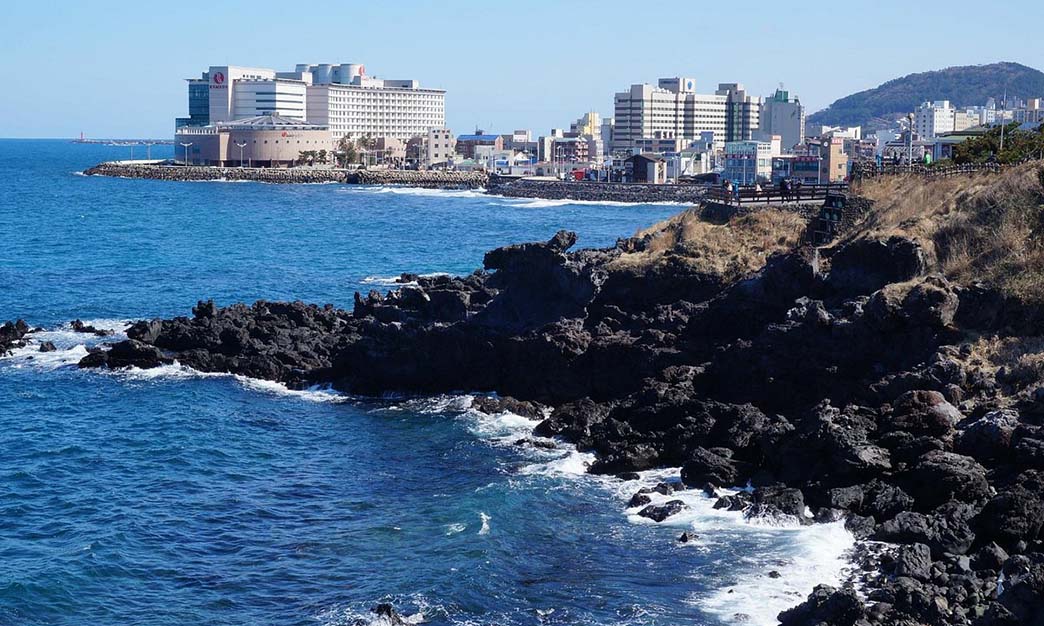
After landing at Jeju International Airport, my first stop was Yongduam Rock (Dragon Head Rock).
It isn’t far from the city center, yet the moment you step onto the shore, the shift in atmosphere is palpable.
The sea breeze hits you directly—salty, humid, and stronger than expected. Standing by the water, you can clearly hear the waves constantly crashing against the rocks.
Yongduam Rock itself is a volcanic formation sculpted by long-term wave erosion. While its shape is distinctive, it feels less like a mere “photo op” and more like a gateway marker for the coastline.
I didn’t linger long here; I simply took a short walk along the shore, getting my first real sense that on Jeju Island, the sea isn’t just scenery—it is the fundamental structure of the landscape.
II. Seongsan Ilchulbong (Sunrise Peak): A Striking Sense of Space at the Crater
On the second day, I visited Seongsan Ilchulbong (Sunrise Peak).
From a distance, it appears to be an isolated green peak rising from the landscape, but up close, you realize it is actually a complete volcanic crater structure.
The climb isn’t particularly difficult, though the wind is intense—growing stronger the closer you get to the summit.
Standing at the rim and looking down, you see a perfect bowl-shaped formation: lush green vegetation covers the perimeter, while the center forms a natural, sunken basin.
Looking outward from the top, the view is a distinct layering of the sea, villages, and distant mountains. At this stop, the impression wasn’t about whether the scenery was “pretty” or not, but rather the sheer power of the terrain itself.
III. Seopjikoji: A Sense of Coastal Expanse
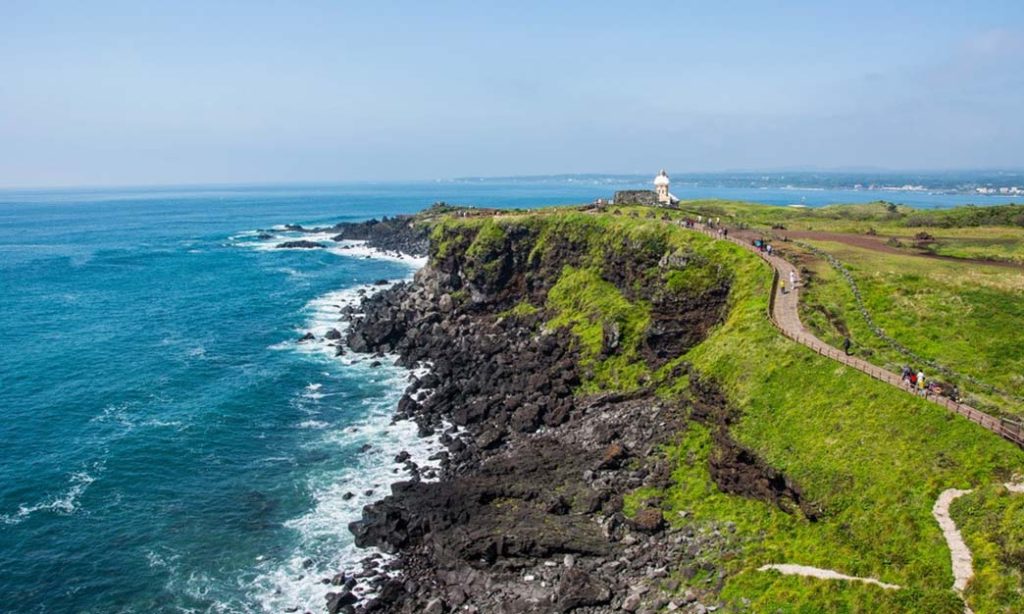
Seopjikoji was a place where I spent a considerable amount of time during my stay on Jeju Island.
Its defining characteristic is a vast, open coastline with a simple, uncluttered layout.
Grassy fields stretch along the seaside, and walking paths follow the natural contours of the land, free from excessive artificial intervention.
As I strolled slowly along the coast, the wind blew steadily and rhythmically.
The sound of the waves shifted slightly depending on where I stood—sometimes intense and crashing, other times soft and gentle.
Unlike the “vertical impact” of Seongsan Ilchulbong (Sunrise Peak), this location offered a spatial experience defined by horizontal expanse.
IV. Udo Island: A Slow-Paced Journey on an Island-within-an-Island
The boat ride from Jeju’s main island to Udo Island felt like a true transition.
Leaving the main island behind, the sea opened up, and the view became pure and unobstructed.
The pace of life on Udo is noticeably slower. The island is primarily defined by a loop route, which visitors can traverse on foot, by bicycle, or via electric vehicle.
I chose to circle the island in an electric vehicle.
Driving along the coast, I had the sea on one side and low-lying terrain and villages on the other—there were no high-rises or densely packed buildings.
The scenery didn’t change drastically from one stretch to the next, yet it was precisely this sense of “steady repetition” that made the experience so relaxing.
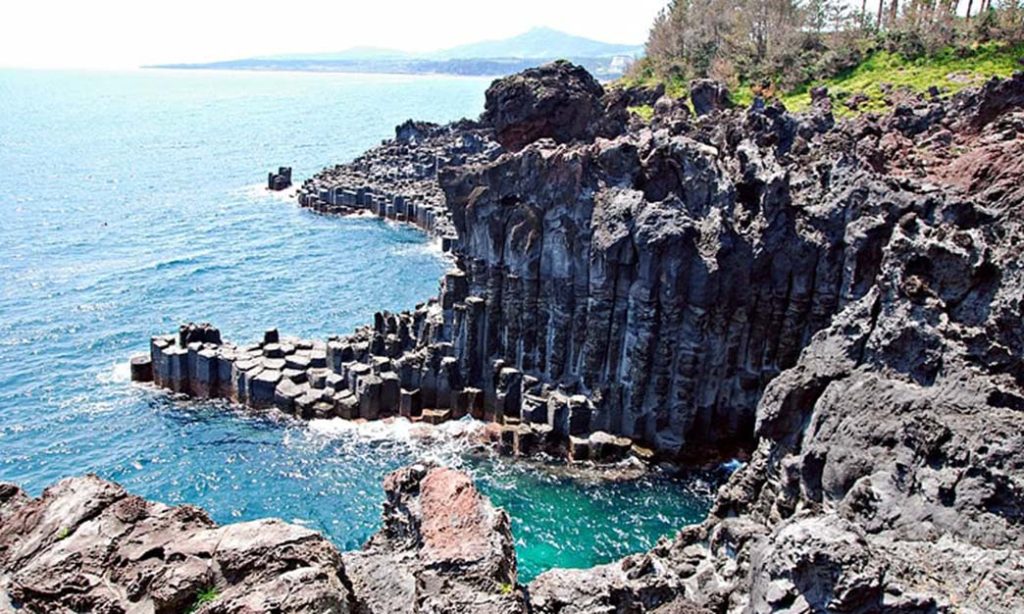
V. Jusangjeolli Cliff: A Direct Collision Between Volcano and Sea
Jusangjeolli Cliff was a geological site on Jeju Island that left a deep impression on me.
The rock formations here display remarkably uniform hexagonal or polygonal structures—a natural phenomenon created as volcanic lava cooled and solidified.
Standing on the observation deck, I watched the waves ceaselessly crashing against these stone pillars.
Each crashing wave created a striking visual impact, yet the rock formations themselves remained steadfast and immovable.
This scene gave me an intuitive sense of the difference in “time scales”—the waves represent the fleeting moment, while the rocks are the product of long, enduring geological processes.
VI. A Distant View of Hallasan: The Ever-Present Center of the Island
Although I did not hike all the way to the summit of Hallasan, the mountain was visible from many parts of Jeju Island.
Whether I was by the coast, on a mountain road, or at the edge of the city, it appeared as a constant “background structure.”
It did not require a dedicated trip like a typical tourist attraction; instead, it served as the central coordinate of the island.
This persistent presence lent a remarkable sense of stability to the spatial structure of Jeju Island as a whole.
VII. Jeju Olle Trails: An Experience Closest to the Essence of Walking
I also walked a section of the Jeju Olle Trails.
The route did not feature mandatory sightseeing stops; rather, it consisted of walking paths that connected nature with local villages.
As I walked, there were few “must-photograph” spots, making it easier to settle into a rhythm of continuous movement.
The scenery shifted between sea, meadows, paths, and villages, yet the overall pace remained gentle and steady.
The Core of Jeju Island Is Its “Natural Structure,” Not a “Collection of Attractions”
Reflecting on my trip to Jeju Island, my strongest impression is that it is not a place for merely “checking off” sights, but a place for “feeling the terrain.” It is the combination of these elements—rather than any single attraction—that defines Jeju Island.
For me, the most significant takeaway from this journey was the realization that travel is not just about viewing scenery; it is about understanding how an island “forms its own structure.”
Jeju Island is precisely that kind of place.