 by
by To be honest, before visiting Jeju Island, my expectations regarding transportation were simple: airport buses, taxis, and rental cars—that was about it.
However, upon arrival, I discovered that Jeju’s transportation wasn’t merely a matter of having “few options,” but rather a completely different structural system. There is no subway, no dense network of transfers, and no high-efficiency system for zipping rapidly across the city. Instead, it is an island defined by its coastline and connected by major arterial roads; here, the act of moving from place to place is an integral part of the journey itself.
I. From Airport to City Center: Stepping into a “Slow-Paced System”
After landing at Jeju International Airport, my first task was to find a way into the city. The airport itself is compact with clear signage, but stepping out of the terminal, you immediately sense the difference between Jeju and a typical metropolis: the space opens up, traffic is sparse, and the pace of life noticeably slows down.
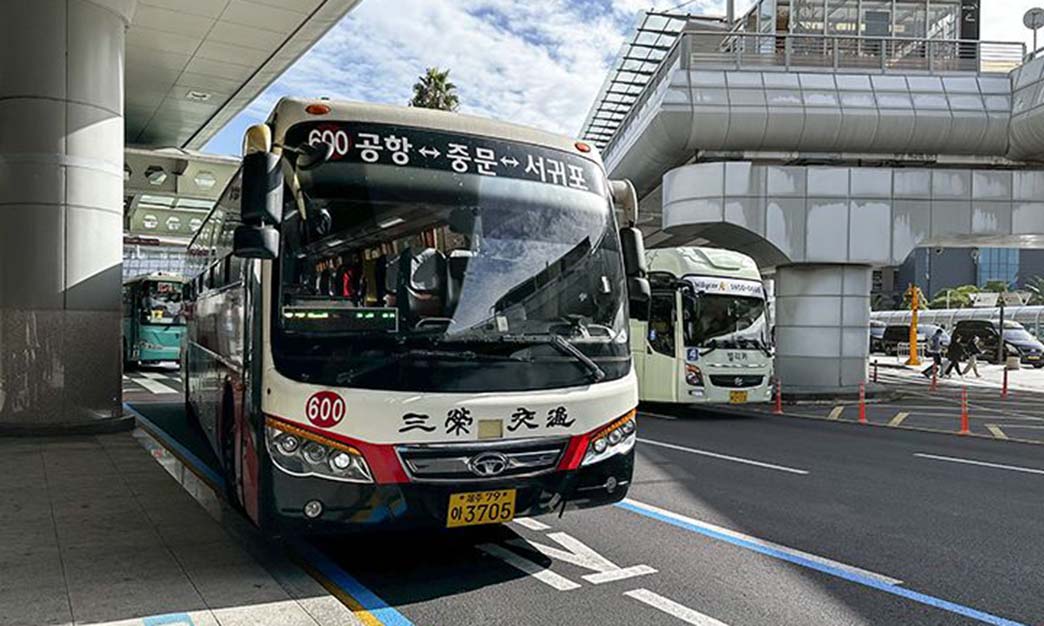
For the first leg of my journey, I chose the airport bus. Boarding was seamless; the stops were right near the exit, requiring no complicated searching. The bus followed a fixed route along the main roads into the city center. As I rode along, I began to notice a shift: buildings grew shorter, roads widened, advertisements became less frequent, and the view outside transformed from fragmented glimpses into a continuous, sweeping panorama.
This journey wasn’t “fast” in the traditional sense, yet it served a unique purpose—it didn’t just rush me to my destination but allowed me to gradually ease into the rhythm of Jeju Island.
II. The Taxi Experience: Reliable but Heavily Dependent on Distance
Taxis became a frequent mode of transport for me on Jeju Island. The overall experience was consistently reliable, though the operational logic differed from that of major cities.
Within the city limits—such as traveling from my hotel to Yongduam Rock or Dongmun Market—taxis were incredibly convenient and readily available. However, for longer distances, the cost was directly reflected in the fare, without the kind of “urban discount structures” often found in big cities.
Drivers relied heavily on navigation systems, and interactions were largely limited to confirming the destination rather than engaging in casual conversation. The experience was smooth, yet strictly functional.
I eventually came to realize that taxis on Jeju Island aren’t designed to “cover the city” in a comprehensive grid; rather, they serve as tools to bridge the gaps between distant points.
III. Renting a Car: The True Way to Experience Jeju Island
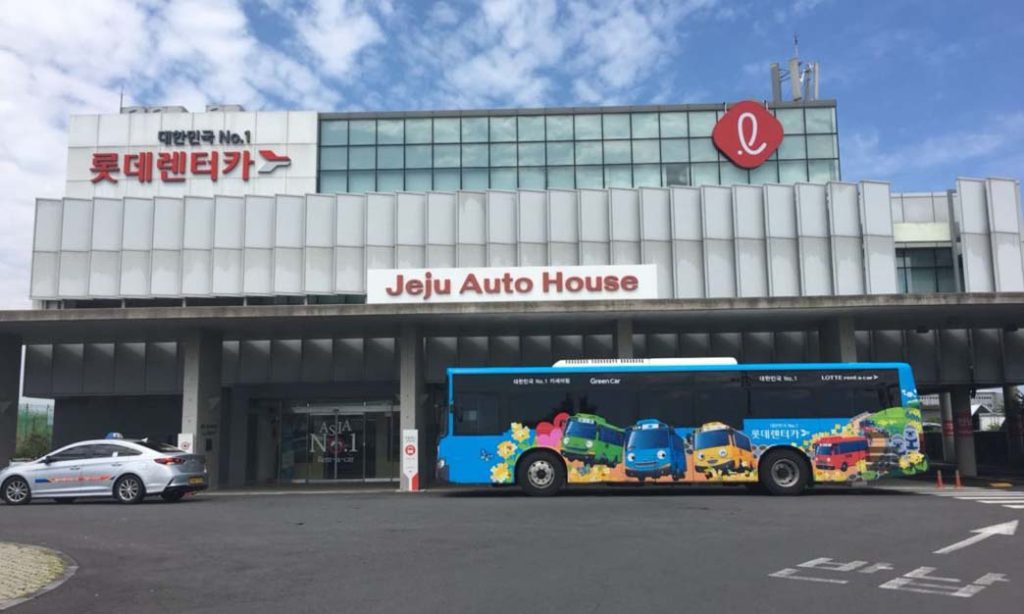
After settling in for a couple of days, I rented a car. This step completely transformed my understanding of transportation on Jeju Island.
Car rental services are concentrated near the airport; there are many companies, and the process is highly standardized. Once I hit the road, my first impression was that the island’s layout suddenly became clear.
The roads are straightforward, traffic is light, and navigation is simple. Most importantly, you have the freedom to adjust your route without being constrained by bus or taxi schedules.
The drive from Jeju City to Seongsan Ilchulbong (Sunrise Peak) was a highlight of the trip. The journey took me from the city to the coast and then into open natural landscapes—a seamless, continuous transition of scenery.
For Jeju Island, self-driving isn’t just about speed; it’s about experiencing the island more fully.
IV. The Bus System: Viable, but Best for a Slower Pace
Jeju Island’s bus system is functional, but it is better suited for a slower style of travel.
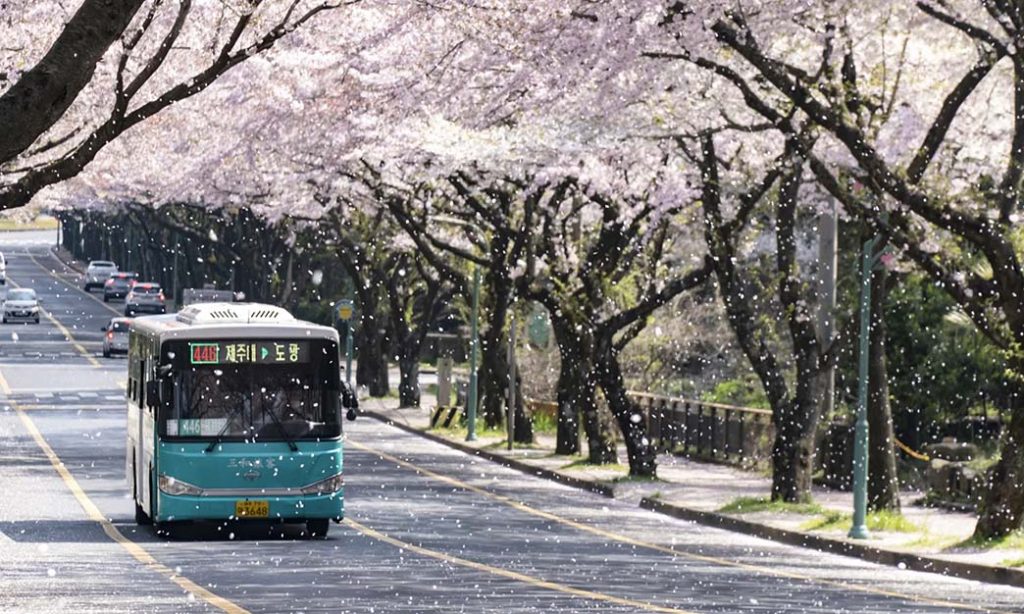
While bus stops are widespread, service intervals are long, and routes are relatively fixed. I once took a bus back to Jeju City from Seogwipo; the experience was fine, but it required careful schedule planning.
Riding the bus gives you a distinct feeling: you aren’t just rushing to a destination, but moving along the island itself. The scenery outside the window shifts slowly as you pass coastlines, villages, and open countryside.
If you aren’t in a rush, the bus offers a great way to observe the surroundings, though it isn’t ideal for hopping frequently between attractions.
V. Island Layout and Movement: Linear Rather Than Networked
After spending some time on Jeju Island, I began to grasp its transportation layout.
It doesn’t feature the “networked” transport system typical of a city; instead, it follows a structure of loops and main arterial roads. Attractions and residential areas are mostly distributed along the coastline and major highways, with open natural or agricultural zones in the interior.
This leads to a common outcome: distances may not look far on a map, but travel times often take longer than expected. For instance, traveling from Jeju City to Seogwipo isn’t merely an intra-city commute; it involves a long-distance journey that traverses the island’s longitudinal layout.
VI. Nighttime Transport: The Island Shifts to “Low-Frequency Mode”
As night falls, traffic on Jeju Island noticeably quiets down.
There are fewer vehicles, bus frequencies drop, and streetlights become more sparsely distributed. Taxis remain available, but the overall pace has shifted to a “low-frequency state.”
I once returned to the city from a coastal attraction at night; there was hardly any traffic on the road—only streetlights and the scattered glow of distant buildings.
It didn’t feel like the end of an urban “evening rush hour”; rather, it felt as though the entire island was settling down to rest.
The Essence of Jeju’s Transport—Redefining “Movement”
Reflecting on the transportation experience in Jeju, my primary takeaway wasn’t about whether it was “convenient” or “inconvenient,” but rather how it fundamentally altered my understanding of movement.
No subways → Space isn’t compressed.
Limited buses → Time becomes more significant.
Taxis → Bridging localized gaps.
Self-driving → Unlocking the island’s overall structure.
Combined, these elements transform travel from a simple journey “from Point A to Point B” into an experience of “moving within the island’s spatial structure.”
For me, the most significant realization was this:
On Jeju Island, transportation is not merely a tool; it is the very means by which you comprehend the island’s spatial logic.